Facebook
Categories
Categories

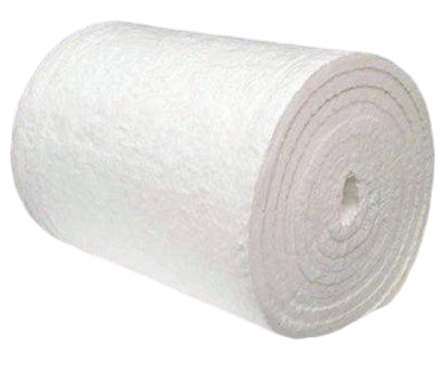
ceramic fiber blanket

This is a flexible inorganic refractory insulation material with alumina and silica as its core components, which is widely used in industrial high-temperature scenarios. Ceramic fiber blanket is produced through electric melting, fiber formation by blow
Mar 26th,2026 32 Views

Ingredients and production process
Core components: Al₂O₃+SiO₂. High purity/high temperature models may contain ZrO₂ (zirconia). The higher the Al₂O₃ content, the better the high temperature resistance;
Process: Raw material is melted at 1800–2000℃ → spun / blown into fibers → collected → double-sided needle punched (to enhance interlacing and tensile strength) → heat set, cut, and rolled; no organic binder, ensuring high temperature stability;
Two major types
Silk-flung blanket: With thick fibers (3–5μm) and long fibers (150–250mm), it boasts high tensile strength and resistance to delamination. It is suitable for block formation and vertical layer paving, and exhibits excellent durability;
Spun (blown) blanket: The fibers are fine (2–3μm) and short (100–200mm), with a slightly lower thermal conductivity, but weaker strength, suitable for flat laying and low-cost scenarios.

Key performance and common specifications
Temperature range: ordinary type 1260℃, zirconium-containing 1430℃, high purity/polycrystalline up to 1600℃; long-term use temperature is 100–200℃ lower than the classification temperature;
Thermal conductivity: Typically ≤0.15 W/(m·K) at 500℃, much lower than that of refractory bricks, achieving significant insulation and energy saving;
Density: Commonly seen at 96, 128 kg/m³ (also available in lower densities such as 64, 80);
Standard dimensions: width 610mm, 1220mm; thickness 6–50 mm; length 3600, 5000, 7200 mm (adjustable according to thickness);
Other characteristics: lightweight, thermal shock resistance, strong chemical inertness, sound absorption and noise reduction, non-combustible (Class A1).
Main applications
Industrial kilns/boiler lining, high-temperature pipeline insulation, and thermal insulation for metallurgical/petrochemical/electric power high-temperature equipment;
Fire-resistant shutters, fire-resistant sealing, fire blankets;
Base material for ceramic fiber modules and folded blocks;
Automobile exhaust pipe, engine heat shield;
Laboratory high-temperature furnaces, aerospace thermal protection components.
Key points of selection and construction
Selection: For temperatures <1200℃, choose 1260 ordinary spun silk; for 1200–1300℃, use zirconium-containing 1430; for vibration/vertical installation, priority is given to spun silk blanket;
Fixing: Use dedicated ceramic anchors and high-temperature nails; it is strictly prohibited to use ordinary metal nails in high-temperature areas;
Sealing: The joints are sealed with ceramic fiber wool/high-temperature adhesive to avoid thermal bridges;
Protection: During construction, it is necessary to wear dust masks, gloves, and protective clothing to prevent fiber dust from irritating the respiratory tract and skin;
Lifespan impact: Avoid frequent rapid cooling and heating, as well as contact with molten metal or strong corrosive media.
Regarding ceramic fiber blanket materials, Foshan Zhiwei Adhesive Products Co., Ltd. is a solution provider. We welcome inquiries from major manufacturers. Contact email: yang@fszw-tapes.com